Run UMAP from precomputed nearest neighbors
Usage
umap_knn(
  indices,
  distances = NULL,
  n_components = 2L,
  seed = 42L,
  verbose = FALSE,
  backend = NULL,
  n.cores = NULL,
  graph_mode = c("fuzzy", "binary")
)
Arguments
- indices
Integer matrix of nearest-neighbor indices, one row per observation, or a KNN object containing
indicesanddistances. One-based and zero-based indices are accepted. A self-neighbor first column is removed automatically.- distances
Numeric matrix matching
indices. Leave asNULLwhenindicesis a KNN object.- n_components
Output dimensionality. The CPU backend supports positive dimensions. Metal and CUDA support two- and three-dimensional embeddings.
- seed
Integer random seed.
- verbose
Print native optimizer progress.
- backend
Execution backend:
"cpu","cuda", or"metal".- n.cores
Requested CPU core count. CPU UMAP currently uses at most four workers and records both requested and effective values.
NULLselects a size-aware default from one to four workers. Native GPU backends ignore this argument.- graph_mode
Graph weighting mode.
"fuzzy"(the default) uses standard UMAP fuzzy graph weights."binary"uses a symmetric unit-weight sensitivity graph.
Value
An embedding matrix with nrow(indices) rows and n_components
columns. Float32 KNN input returns a float::float32 layout; ordinary R
input returns a numeric matrix. Resolved settings are stored in
attr(layout, "fastEmbedR_config").
Details
This KNN-input function exposes the same deliberately constrained optimizer
policy as umap(). It reuses the supplied neighbors but still selects
epochs, minimum distance, spread, learning rate, repulsion strength,
negative-sample rate, spectral iterations, and backend update mode
internally. The resolved configuration is attached as
attr(layout, "fastEmbedR_config"). Pass an object from umap_init() to
reuse both the prepared graph and package-native initialization. Prepared
CUDA graph reuse currently supports two dimensions; ordinary KNN CUDA fits
also support three. This API is
intended for fixed-boundary comparisons and repeated seeds, not arbitrary
UMAP hyperparameter sweeps.
Examples
x <- scale(as.matrix(iris[, 1:4]))
d <- as.matrix(stats::dist(x))
diag(d) <- Inf
k <- 10L
idx <- t(apply(d, 1L, order))[, seq_len(k), drop = FALSE]
dst <- matrix(
    d[cbind(rep(seq_len(nrow(d)), each = k), as.vector(t(idx)))],
    nrow = nrow(d), byrow = TRUE
)
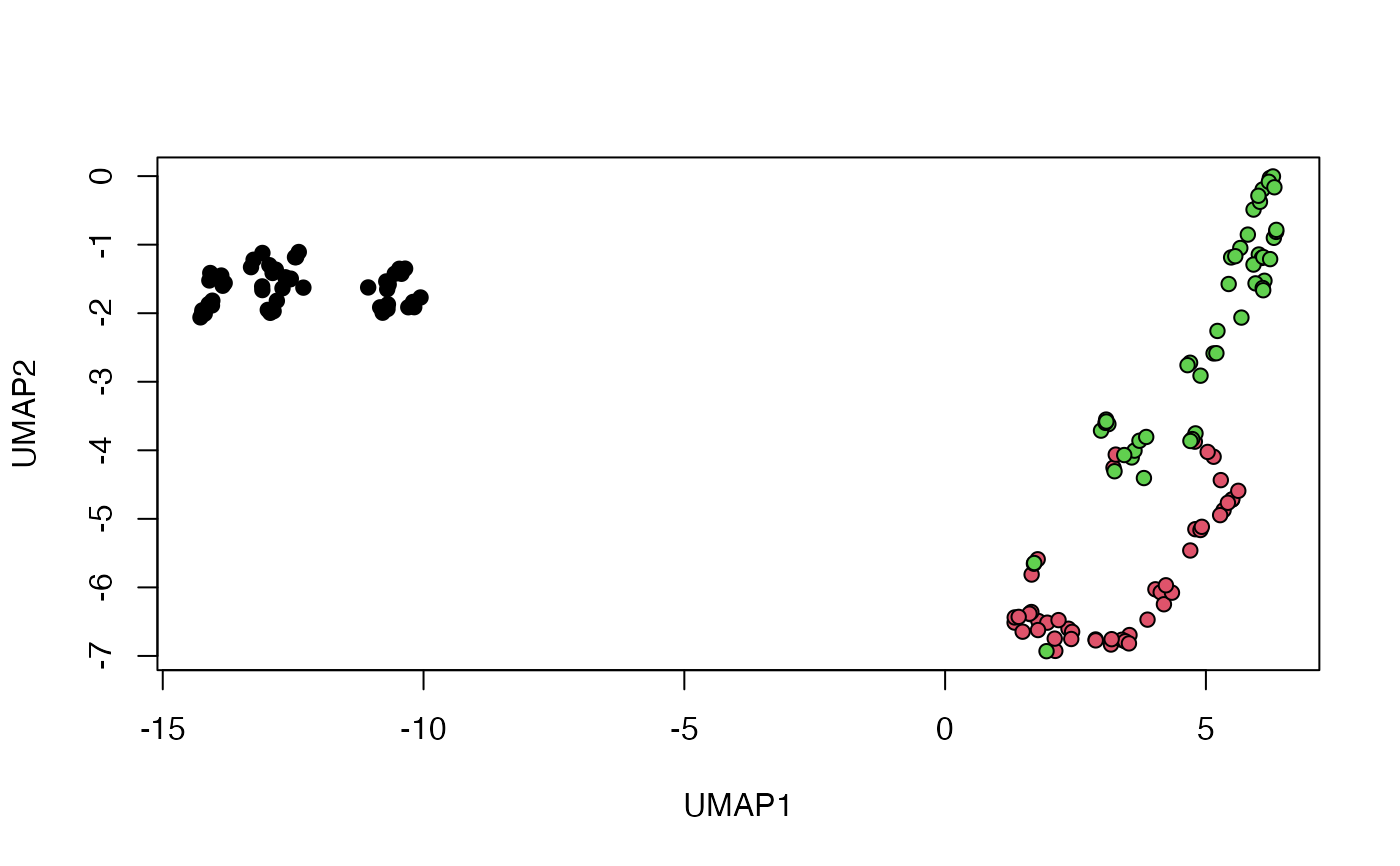
layout <- umap_knn(idx, dst, seed = 1)
plot(layout, pch = 21, bg = iris$Species)