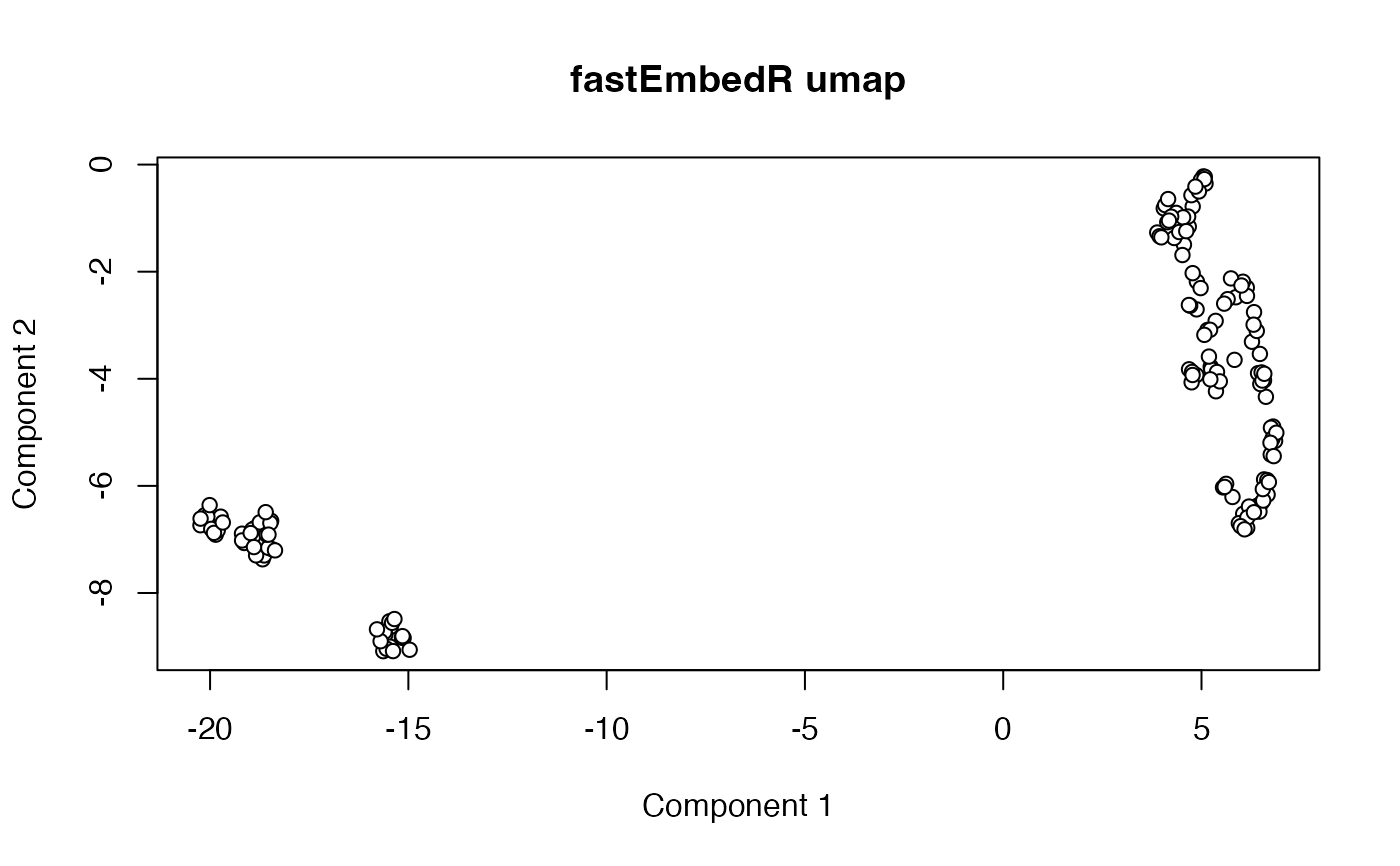
umap() is a small convenience wrapper. If data is already a list of KNN
indices and distances, it calls umap_knn() directly. Otherwise it
preprocesses the data, computes KNN once with fastEmbedR's native backend,
and embeds from that KNN graph.
Usage
umap(
  data,
  n_neighbors = NULL,
  n_components = 2L,
  standardize = FALSE,
  pca_dims = NULL,
  metric = c("euclidean", "cosine", "correlation"),
  nn = NULL,
  seed = 4L,
  backend = NULL,
  n.cores = NULL,
  keep_knn = FALSE,
  graph_mode = c("fuzzy", "binary"),
  verbose = FALSE,
  landmarks = FALSE,
  transform_k = NULL,
  massive = "off",
  output = NULL,
  chunk_rows = NULL,
  memory_limit = "8GB",
  refinement_epochs = 0L,
  local_refine = FALSE,
  local_neighbors = 15L,
  overlap_rows = 500L,
  devices = NULL,
  landmark_method = "reservoir",
  init = NULL,
  layout_storage = "memory",
  checkpoint = FALSE,
  resume = FALSE
)
Arguments
- data
Numeric matrix/data frame, or a list containing KNN
indicesanddistances.- n_neighbors
Number of non-self neighbors.
NULLchooses the package default for the data size.- n_components
Output dimensionality. The CPU backend supports positive dimensions. Metal and CUDA support two- and three-dimensional embeddings.
- standardize
Center and scale columns before KNN when
datais a matrix. Defaults toFALSEso one-call results match a KNN object computed from the supplied matrix.- pca_dims
Optional PCA dimension before KNN.
- metric
KNN distance metric for one-call matrix input:
"euclidean","cosine", or"correlation".- nn
Optional precomputed KNN result for resident matrix input. In EXPERIMENTAL
massive = "landmark"mode, a previous massive landmark embedding reuses its saved selection and query-to-landmark KNN. Its source, reference, neighbor count, and backend must match.- seed
Random seed.
- backend
Execution backend:
"cpu","cuda", or"metal". CPU KNN uses package-native exact search below 5,000 rows and HNSW otherwise. Metal uses package-native exact or recall-tuned IVF-Flat search. CUDA uses cuVS brute-force exact search below 100,000 rows and cuVS IVF-Flat above that threshold. The KNN result stays on the device through graph construction and optimization. GPU requests must resolve to a real native backend; the package does not relabel CPU work as GPU.- n.cores
Requested CPU core count. For matrix input, the value is passed to CPU PCA preprocessing, KNN, and UMAP. UMAP uses at most four workers and records both requested and effective values. With
NULL, PCA usesoptions(n.cores)(one by default); KNN and UMAP use their stage defaults. Native GPU stages ignore this argument.- keep_knn
Keep KNN matrices in the returned object.
- graph_mode
Graph weighting mode.
"fuzzy"(the default) uses the standard UMAP fuzzy graph."binary"uses a symmetric unit-weight graph as an adjacency-only sensitivity approximation; it is not standard UMAP or necessarily faster.- verbose
Print progress.
- landmarks
FALSE(the default) embeds all observations. A fraction in(0, 1), a positive landmark count, or explicit row indices enables landmark embedding followed by fixed-reference projection of the remaining rows.- transform_k
Number of landmark neighbors used to project non-landmark observations. Used only when
landmarksenables landmarking and defaults ton_neighbors.- massive
"off"(default), experimental"landmark", or"out_of_core_graph". Landmarking is always explicit. The full-graph route needs a symmetric fuzzymassive_umap_fuzzy_graph()and file-backedinit. The experimental CUDA full-graph route requires a device-resident 2D layout.- output
New
.f32path for experimental file-backed coordinates.- chunk_rows
Maximum experimental query rows per batch.
- memory_limit
Conservative experimental RAM budget.
- refinement_epochs
Fixed-reference UMAP projection epochs in experimental mode. Defaults to zero on CPU and CUDA; CUDA currently rejects positive values.
- local_refine
Enable EXPERIMENTAL bounded query-to-query graph refinement in massive landmark mode. Requires CPU and positive epochs.
- local_neighbors
Non-self neighbors in each local query window.
- overlap_rows
Extra rows on each side of a local query window; at least
local_neighbors.- devices
Optional CUDA device indices for experimental landmark query projection. Reference fitting and KNN use the first device.
- landmark_method
Sampling method for experimental landmark mode:
"reservoir"(default) or"random"for fast random-access storage. Auto mode uses ordinary UMAP when its conservative memory estimate fits; otherwise it reports and runs approximate landmark UMAP. The landmark route requires a file-backedmassive_matrix()and a new.f32output.- init
File-backed 2D or 3D initial coordinates for experimental full-graph UMAP. Other routes do not accept this argument.
- layout_storage
"memory"(default),"mmap"for a writable CPU mapping, or"managed"for CUDA managed-memory coordinates in experimental full-graph UMAP. CUDA rejects"mmap".- checkpoint
Save experimental workflow stages and completed batches. Only available for massive landmark or full-graph mode.
- resume
Continue a matching interrupted experimental workflow. Changed input, backend, or fit controls fail without recomputation.
Value
A fastEmbedR_embedding object. Landmark fits also contain model,
which can be passed to project_landmark_model() for new observations.
Details
umap() is an opinionated high-throughput UMAP implementation rather than
a drop-in interface for every UMAP hyperparameter. The public matrix-input
API exposes neighborhood size, distance metric, graph weighting, output
dimension, preprocessing, backend, seed, and CPU thread count. In the
current release, epochs, minimum distance, spread, learning rate, repulsion
strength, negative-sample rate, spectral iteration count, and asynchronous
update mode are selected internally. The resolved values and rule names are
stored in fit$parameters.
The default policy uses 500 epochs below 10,000 observations and 200 epochs
for larger inputs, increasing to 300 for high-variability distance profiles;
five negative samples, spread 1, and repulsion strength 1 are fixed. Minimum
distance is normally 0.01 and becomes 0.1 only under the documented
wide-shell profile; learning rate is correspondingly 1 or 1.25. Use
umap_init() to precompute and reuse package-native initial coordinates,
or umap_knn() to supply an externally controlled KNN graph. These controls
are scientifically consequential; fixing them is a scope
decision made to keep one tested objective and update schedule aligned across
CPU, Metal, and CUDA, not a claim that the values are universally optimal.
Arbitrary min_dist, spread, epoch, learning-rate, negative-sampling, or
optimizer-mode sweeps should use a
general-purpose UMAP implementation; fastEmbedR does not claim API or
parameter interchangeability with those packages.
Landmark mode fits the requested fuzzy or binary UMAP graph on the
landmark rows, projects the remaining rows with query-to-reference KNN, and
optionally refines only projected rows while landmark coordinates remain
fixed. Metal and CUDA landmark refinement currently requires 2D output;
3D landmark requests fail explicitly. Resident precomputed KNN input
cannot be combined with landmarking.
The returned model retains the fitted preprocessing transform so new data
can be supplied in the same original feature space.