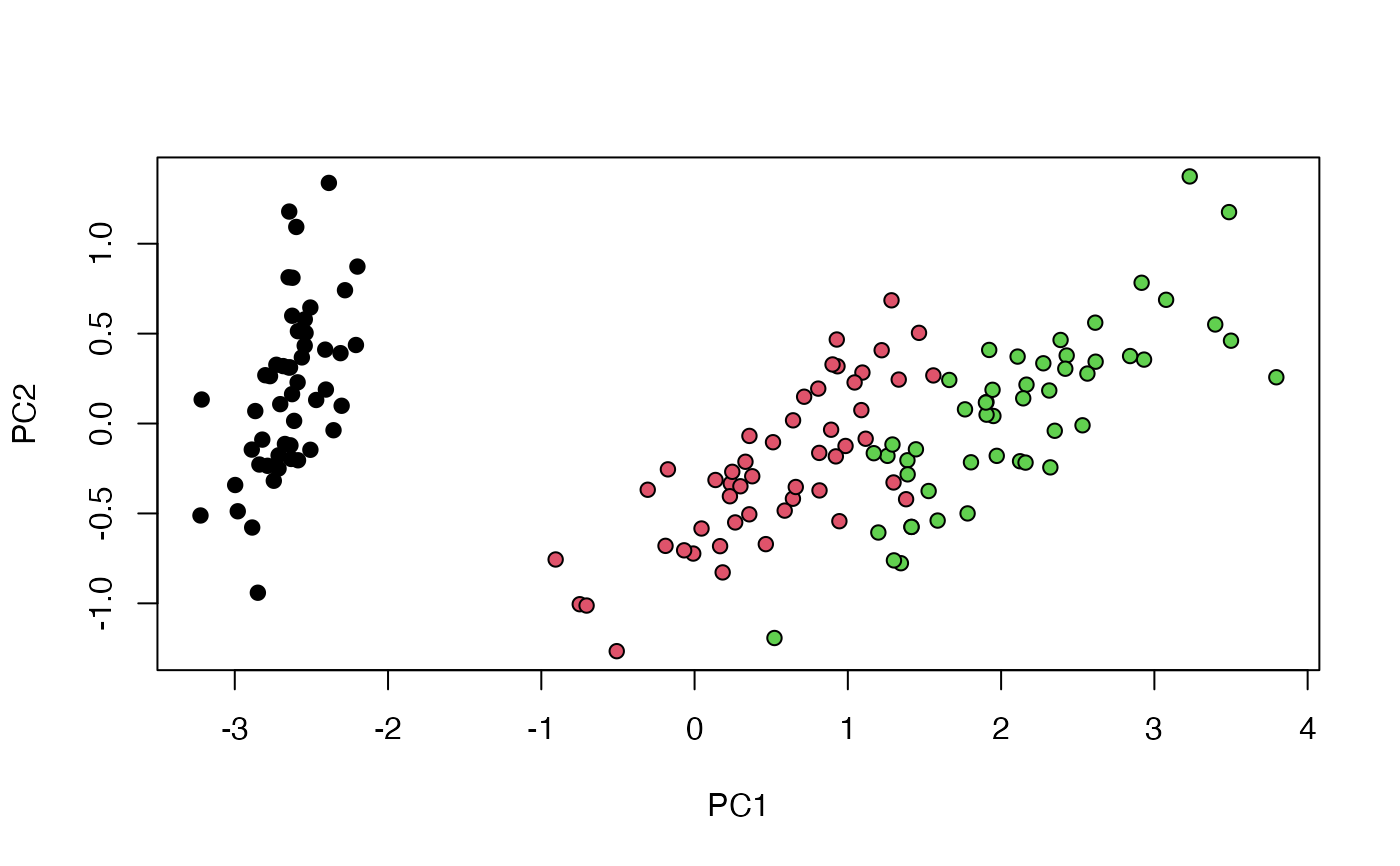
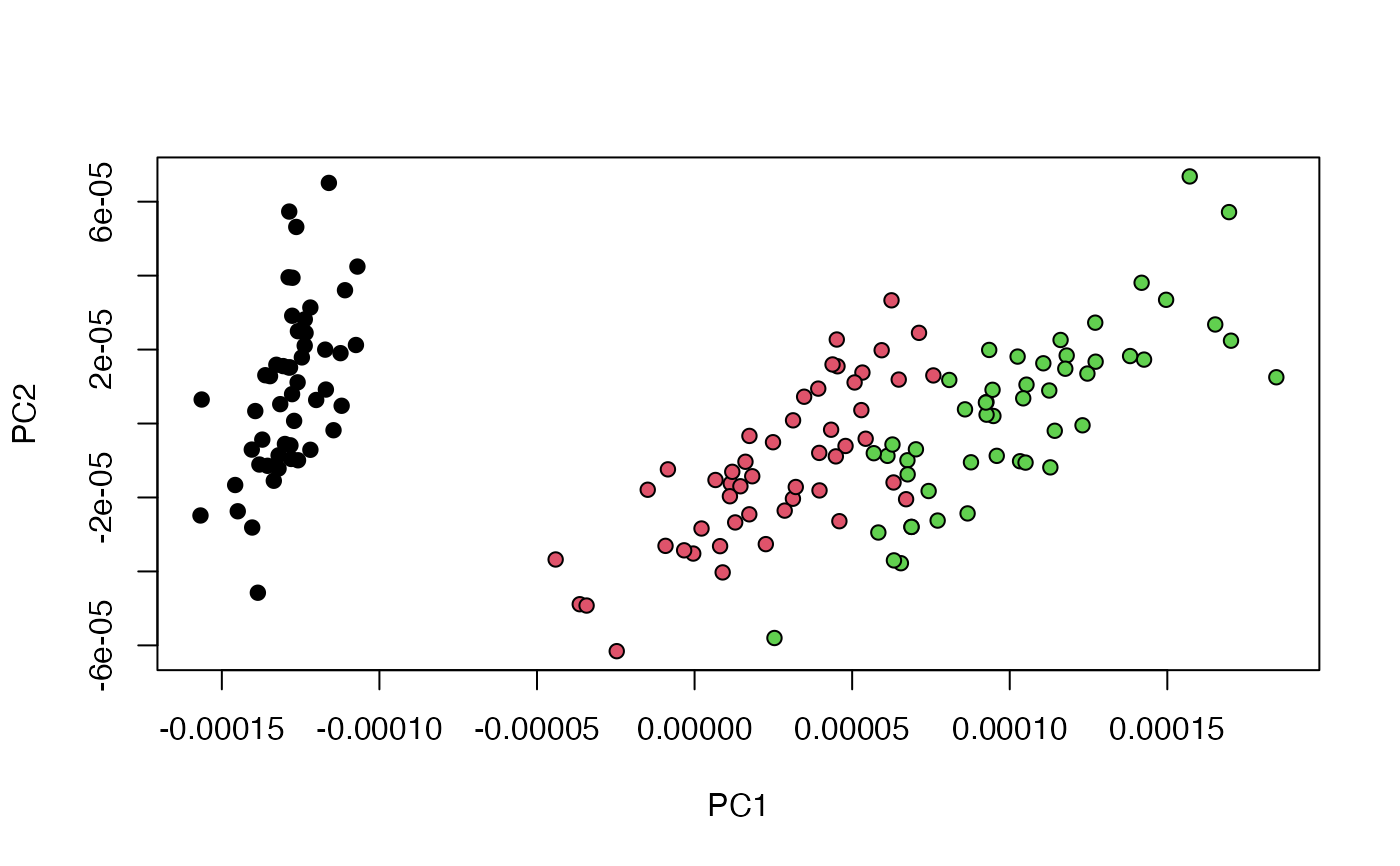
pca() computes principal component scores with a backend-native truncated
decomposition. CPU uses a package-native float32 blocked randomized SVD
(rSVD). Metal uses a package-native float32 block-subspace rSVD whose large
matrix products are executed with Metal Performance Shaders. CUDA selects
between package-native float32 rSVD and, when enabled, RAPIDS RAFT TSVD
from the matrix shape, requested rank, and estimated arithmetic cost.
Wide, low-rank problems favor rSVD; smaller, narrower, or less-truncated
problems favor TSVD. Without RAFT, CUDA uses native rSVD. CUDA requests
fail explicitly when CUDA is unavailable; they never fall back to CPU PCA.
Usage
pca(
  x,
  ncomp = 2L,
  xtest = NULL,
  center = TRUE,
  scale = FALSE,
  backend = NULL,
  n.cores = NULL,
  seed = 4L,
  tsne_init = FALSE,
  massive = "off",
  output = NULL,
  chunk_rows = NULL,
  memory_limit = "512MB",
  checkpoint = FALSE,
  resume = FALSE,
  devices = NULL
)
Arguments
- x
Numeric matrix/data frame or
float::float32matrix with observations in rows.- ncomp
Number of principal components.
- xtest
Optional test/query matrix with the same columns as
x. Projected coordinates are returned inscores_test.- center
If
TRUE, mean-center columns before decomposition.- scale
If
TRUE, scale centered columns to unit sample standard deviation before decomposition.- backend
PCA backend:
"cpu","cuda", or"metal".- n.cores
Positive integer CPU worker limit. Small stages use fewer workers automatically. On Linux, BLAS and OpenMP are limited to one thread while native workers are active to prevent nested parallelism. On macOS, Accelerate may use the requested limit. In experimental out-of-core CUDA PCA it controls the streamed CPU mean pass. It is otherwise ignored by Metal and CUDA.
- seed
Random seed for backends that use a Gaussian subspace sketch, including experimental wide streamed CPU or CUDA PCA. The RAFT covariance-eigensolver route records but does not consume this value.
- tsne_init
If
TRUE, addtsne_initto the returned PCA object. This matrix is centered and rescaled so its largest component standard deviation is1e-4, ready to pass asY_inittotsne()ortsne_knn().- massive
"off"(default) keeps the existing in-memory route."auto"estimates memory and selects the in-memory route when safe, otherwise streamed PCA."out_of_core"explicitly activates covariance PCA for amassive_matrix()source with at most 1024 columns on CPU or 2048 on CUDA. Wider matrices use randomized streamed PCA. Wide CUDA streams the mean and scale passes on CPU, runs its sketch and projection on CUDA, and reports stage backends. Metal streaming is unavailable and fails explicitly.- output
Required
.f32score-file path in out-of-core mode, including when auto mode selects that route.- chunk_rows
Maximum rows read per block in out-of-core mode.
- memory_limit
Conservative RAM budget for out-of-core buffers and any resident R-matrix input, for example
"512MB"or"16GB". This does not limit R itself or linked-library memory.- checkpoint
Save the experimental out-of-core PCA model and completed score batches beside
outputfor recovery.- resume
Continue from a matching PCA checkpoint and partial score file. Available when out-of-core processing is selected.
- devices
Optional distinct CUDA device IDs for experimental file-backed PCA score projection. The decomposition runs on the first selected device; projection rows are sharded across devices. Optional checkpointing saves the decomposition and completed shard blocks; resume requires the same input, settings, and device list.
Value
A fastEmbedR_pca list with scores, loadings,
singular_values, centering/scaling vectors, backend metadata, and
decomposition metadata. When tsne_init = TRUE, the list also
contains tsne_init; when xtest is supplied, it also contains
scores_test. Metal and CUDA preserve float::float32 scores, loadings,
initialization, and compatible test projections when the input is
float32. CPU results also record the worker and BLAS limits.
Details
CPU matrix products and factorizations use the BLAS/LAPACK linked to R.
Set n.cores to control their CPU core limit. The requested value is
applied temporarily through standard BLAS/OpenMP environment variables and,
when installed, RhpcBLASctl; the prior process settings are restored after
the call. A single-threaded BLAS can still report one effective thread. With
float::float32 input, native Metal and CUDA preprocessing and the returned
scores/loadings also remain float32. The API intentionally has no
decomposition method menu and does not call Python. Explicit unavailable GPU
requests fail instead of being reported as GPU work.