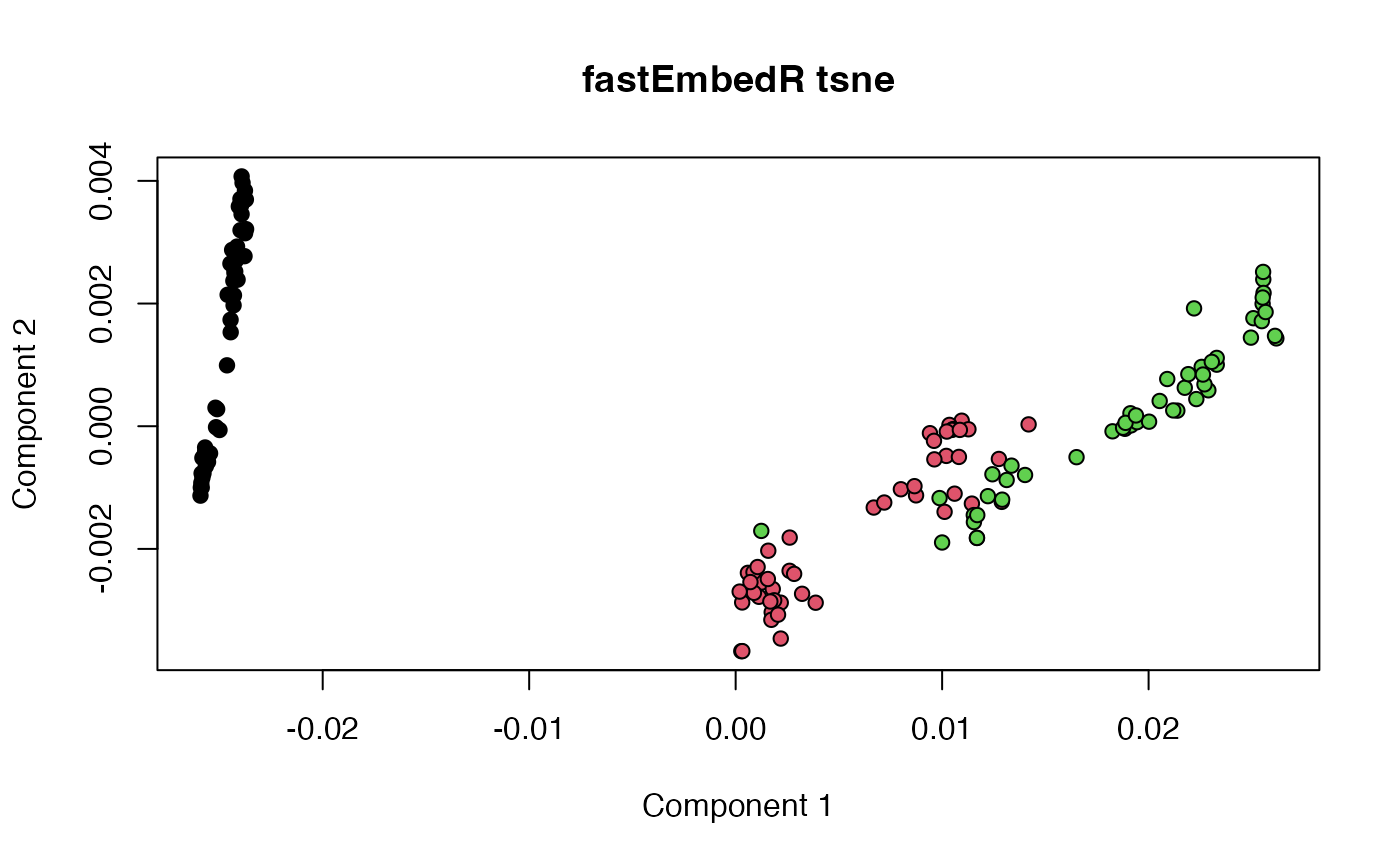
tsne() computes or reuses a KNN graph, then runs the package-native
two-phase t-SNE optimizer. The default optimizer is CPU-native.
Explicit backend = "metal" and backend = "cuda" requests use the
matching package-native GPU optimizer when compiled and fail clearly if the
requested backend is unavailable.
The implementation follows published sparse-affinity and interpolation-based
t-SNE methods and provides independent CPU, Metal, and CUDA kernels.
Usage
tsne(
  data,
  perplexity = NULL,
  n_components = 2L,
  init_data = NULL,
  Y_init = NULL,
  standardize = FALSE,
  pca_dims = NULL,
  metric = c("euclidean", "cosine", "correlation"),
  nn = NULL,
  seed = 4L,
  backend = NULL,
  keep_knn = FALSE,
  verbose = FALSE,
  n.cores = NULL,
  learning_rate = "auto",
  early_exaggeration_iter = NULL,
  early_exaggeration = "auto",
  n_iter = NULL,
  exaggeration = NULL,
  initial_momentum = 0.8,
  final_momentum = 0.8,
  max_step_norm = "auto",
  negative_gradient_method = "auto",
  record_costs = FALSE,
  auto_config = TRUE,
  landmarks = FALSE,
  transform_k = NULL,
  transform_perplexity = 5,
  transform_iter = 250L,
  transform_early_exaggeration_iter = 0L,
  transform_n_negatives = NULL,
  initialization = c("median", "weighted", "random"),
  massive = "off",
  output = NULL,
  chunk_rows = NULL,
  memory_limit = "8GB",
  devices = NULL,
  landmark_method = "reservoir",
  checkpoint = FALSE,
  resume = FALSE,
  ...
)
Arguments
- data
Numeric matrix/data frame with observations in rows, a list containing KNN
indicesanddistances, or an experimental saved affinity graph formassive = "out_of_core_graph".- perplexity
t-SNE perplexity. If
NULL, uses the largest safe value up to 30 that is available for the input. Compact affinity support usesceiling(perplexity)non-self neighbors.- n_components
Output dimensionality, 2 or 3. FFT repulsion is used on every backend.
- init_data
Optional original high-dimensional data matrix used only to compute PCA initialization. It is not used for neighbor search or optimization.
- Y_init
Optional explicit initial layout. In full-graph massive mode this must be a 2D or 3D file-backed
.f32matrix. Usepca(data, tsne_init = TRUE)$tsne_initto precompute and reuse a PCA initialization.- standardize
Center and scale columns before KNN. Defaults to
FALSEso one-call results match a KNN object computed from the supplied matrix.- pca_dims
Optional PCA dimension before KNN.
- metric
KNN distance metric for one-call matrix input:
"euclidean","cosine", or"correlation".- nn
Optional precomputed KNN output for resident matrix input. In EXPERIMENTAL
massive = "landmark"mode, a previous massive landmark embedding reuses its saved selection and query-to-landmark KNN. Its source, reference, neighbor count, and backend must match.- seed
Random seed.
- backend
Execution backend:
"cpu","cuda", or"metal". CPU KNN uses package-native exact search below 5,000 rows and HNSW otherwise. Metal uses package-native exact or recall-tuned IVF-Flat search. CUDA uses cuVS brute-force exact search below 100,000 rows and cuVS IVF-Flat above that threshold. Device pointers pass directly to the native CUDA t-SNE optimizer. Unsupported GPU requests fail clearly and are not relabelled CPU runs.- keep_knn
If
TRUE, retain KNN matrices in the returned object.- verbose
Print optimizer progress.
- n.cores
Number of CPU cores used by CPU PCA preprocessing, KNN, and t-SNE optimization. With
NULL, PCA usesoptions(n.cores)(one by default), while KNN and t-SNE use their stage defaults. Native GPU stages ignore this argument.- learning_rate
Positive number or
"auto". With"auto", the native optimizer usesn / exaggerationseparately for each phase.- early_exaggeration_iter
Number of early-exaggeration iterations.
- early_exaggeration
Early-exaggeration multiplier, or
"auto"for the default t-SNE rule.- n_iter
Number of normal optimization iterations after early exaggeration.
- exaggeration
Normal-phase exaggeration.
NULLmeans 1.- initial_momentum
Momentum during early exaggeration.
- final_momentum
Momentum during normal optimization.
- max_step_norm
Maximum per-point update norm.
"auto"uses the same validated limit on CPU, Metal, and CUDA. UseNULLorNAto disable clipping.- negative_gradient_method
"auto"or"fft"; both use FFT. Other methods fail explicitly. GPU FFT requires compiled native symbols.- record_costs
If
TRUE, compute diagnostic KL/cost traces. CUDA and three-dimensional Metal fits reject this option explicitly.- auto_config
If
TRUE, choose missing t-SNE settings with a native C++ opt-SNE-inspired policy. The policy usesn / early_exaggerationfor"auto"learning rate, chooses missing iteration limits, and enables KLD-based early stopping on small CPU runs where the monitor is not prohibitively expensive. Explicit user-supplied values are respected.- landmarks
FALSE(the default) embeds all observations. A fraction in(0, 1), a positive landmark count, or explicit row indices enables landmark embedding followed by fixed-reference transformation of the remaining rows.- transform_k
Number of landmark neighbors used to place non-landmark observations. Used only when landmarking is enabled.
- transform_perplexity
Perplexity used to transform non-landmark rows.
- transform_iter
Number of normal transform iterations. Use zero for projection without transform refinement.
- transform_early_exaggeration_iter
Number of transform early-exaggeration iterations.
- transform_n_negatives
Number of sampled reference negatives used by large fixed-reference transforms.
- initialization
Initial placement for transformed rows:
"median","weighted", or"random".- massive
"off"(default), experimental"landmark", or"out_of_core_graph"for a prepared t-SNE affinity graph. Landmarking is always explicit.- output
New
.f32path for experimental file-backed coordinates.- chunk_rows
Maximum experimental query rows per batch.
- memory_limit
Conservative experimental RAM budget.
- devices
Optional CUDA device indices for experimental landmark query projection. Reference fitting and KNN use the first device.
- landmark_method
Sampling method for experimental landmark mode:
"reservoir"(default) or"random"for fast random-access storage. Auto mode uses ordinary t-SNE when its conservative memory estimate fits; otherwise it reports and runs approximate landmark t-SNE. The landmark route requires a file-backedmassive_matrix()and a new.f32output. Full-graph mode streams affinities into the CPU FFT optimizer and currently has no CUDA route.- checkpoint
Save experimental workflow stages. Full-graph t-SNE also saves coordinates, momentum updates, and adaptive gains every 100 iterations and at the final iteration.
- resume
Continue a matching interrupted experimental workflow. Changed input, backend, or fit controls fail without recomputation.
- ...
Additional low-level parameters passed to
tsne_knn().
Value
A fastEmbedR_embedding object. Landmark fits also contain model,
which can be passed to project_landmark_model() for new observations.
Details
The t-SNE API exposes the principal
scientifically consequential optimizer controls: perplexity,
initialization, iteration counts, early and normal exaggeration,
learning rate, momentum, and clipping. FFT repulsion is fixed. Setting
auto_config = FALSE disables automatic iteration and stopping choices;
explicit values always override automatic values. The matrix-input function
deliberately does not expose a nearest-neighbor index type or tuning
parameters: it uses the backend router with target recall 0.99. Supply an
externally generated KNN object to tsne_knn() when search policy must be
controlled independently. The resolved settings are returned in
fit$parameters. Affinity construction always uses compact support with
k = ceiling(perplexity) non-self neighbors. Landmark mode embeds the
selected reference rows with the same t-SNE implementation and transforms
all remaining rows while keeping the reference coordinates fixed.
Resident precomputed KNN input and explicit init_data or Y_init
cannot be combined with landmarking.